
Role of Miyawaki Forests in Indian Cities
When we talk about “ecological services” in cities—cooler micro‑climate, clean air, groundwater recharge, biodiversity, mental health benefits—people often imagine big old trees with wide canopies. This picture is partly true, but also incomplete.
Research on urban forests shows that all age classes of trees contribute to ecosystem services, while large, mature trees usually provide the highest benefits per tree. At the same time, dense native plantings like Miyawaki forests can start delivering many of these services surprisingly early and then keep increasing their impact as they grow.
In this blog, I will explain how ecological services work across different forest ages, and where Miyawaki afforestation fits into a long‑term urban forest strategy.
What are urban ecological services?
Urban forests are now recognized as essential green infrastructure rather than just decoration. They provide four broad categories of ecosystem services:research.fs.usda
- Regulating services – cooling the city, reducing air pollution, intercepting rainwater, reducing flood risk, stabilizing soil, buffering noise.
- Supporting services – soil formation, nutrient cycling, habitat for fauna and flora, pollination.
- Provisioning services – small-scale fuelwood, fruits, fodder, non‑timber forest products where appropriate.
- Cultural services – recreation, aesthetics, spiritual connection, stress reduction, social cohesion, place identity.
The list in your reference image (climate, biodiversity, pollution, water & soil, work, community, public health, social, locomotion, etc.) is consistent with global urban‑forest literature and policy briefs.

Do these services require mature trees only?
No. Many ecological services begin as soon as vegetation is established, and increase with time as trees gain height, biomass, and canopy area.
Services that start early (young–medium age)
Even a 3–5 year old plantation can significantly improve:
- Surface cooling and thermal comfort through shading of bare soil, evapotranspiration, and reduction of reflected heat from hard surfaces.journals.plos+2
- Stormwater regulation by intercepting rainfall on leaves and increasing infiltration via improved soil structure and root channels.journals.plos+1
- Air quality by creating roughness that slows air movement, trapping particulate matter on foliage, and beginning gas exchange.usda
- Habitat creation for insects, birds, reptiles, small mammals and soil biota as structural complexity and litter layer appear.ejournal.unsrat.ac
- Psychological and social benefits—visual greenery, opportunities for walking, relaxation, and community interaction—do not wait for “old‑growth” conditions. Even short-term exposure to small urban forests improves mood, reduces stress and supports mental health.journals.plos+2
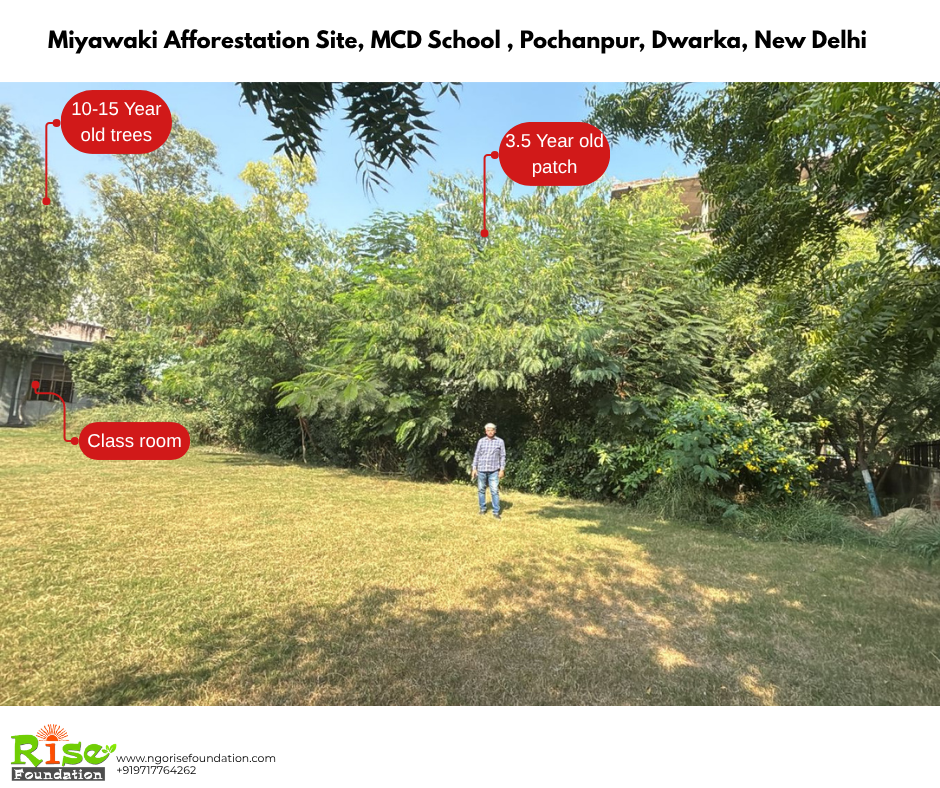
Services where mature trees dominate
For some services, large and old trees are irreplaceable:
- Carbon storage and sequestration per individual tree – big trees store orders of magnitude more carbon than saplings and continue sequestering carbon for many decades.squ.elsevierpure
- Deep shade and strong heat‑island mitigation at the city scale – requires high canopy cover and crown volume that only mature trees can provide.journals.plos
- Long‑term habitat for cavity‑nesting birds, epiphytes, bats, and specialized fauna – these depend on large trunks, hollows and microhabitats that form slowly.
Large old trees have been shown to provide up to 10 times more ecosystem services compared with young trees on a per‑tree basis. That is why current urban‑forest science strongly emphasizes protecting existing mature trees first, and then adding new plantings.
Where does Miyawaki afforestation fit in?
Recent reviews of the Miyawaki technique in urban environments highlight several key points:pmc.ncbi.nlm.nih+1
- Fast establishment and high density: Carefully selected native species, high planting density and intensive early care produce dense canopy in 3–5 years in many climates.
- Rapid micro‑climate and soil improvement: The thick mulch, soil amelioration, and layered planting quickly improve soil structure, moisture retention and organic matter, supporting infiltration and reducing erosion.
- Biodiversity support: Multi‑layered, native species assemblages create diverse niches and attract a rich set of insects, birds and other fauna relative to typical ornamental landscaping.
- Social and educational benefits: Tiny forests are highly visible, community‑friendly interventions that generate environmental awareness and local stewardship.
At the same time, the literature also notes limitations and controversies: cost of soil preparation, long‑term maintenance in some contexts, land availability in dense urban cores, and sometimes negative public perception of “wild” or “messy” vegetation.ejournal.unsrat.ac
Miyawaki forests vs. mature street trees
Instead of treating them as competitors, it is better to see them as complements:
- Mature avenue trees: provide strong, continuous canopy over roads, footpaths and built form—excellent for shade, cooling, air‑pollution control along traffic corridors, and sense of place.
- Miyawaki patches: convert small, unused or degraded plots into high‑biodiversity mini‑forests that excel at habitat, infiltration, noise buffering, and educational/recreational value.
A city that protects its mature trees while also strategically inserting Miyawaki forests and other green infrastructure (wetlands, green roofs, parks, agroforestry) will maximize the full set of ecological services.
 Rise Foundation (NGO)