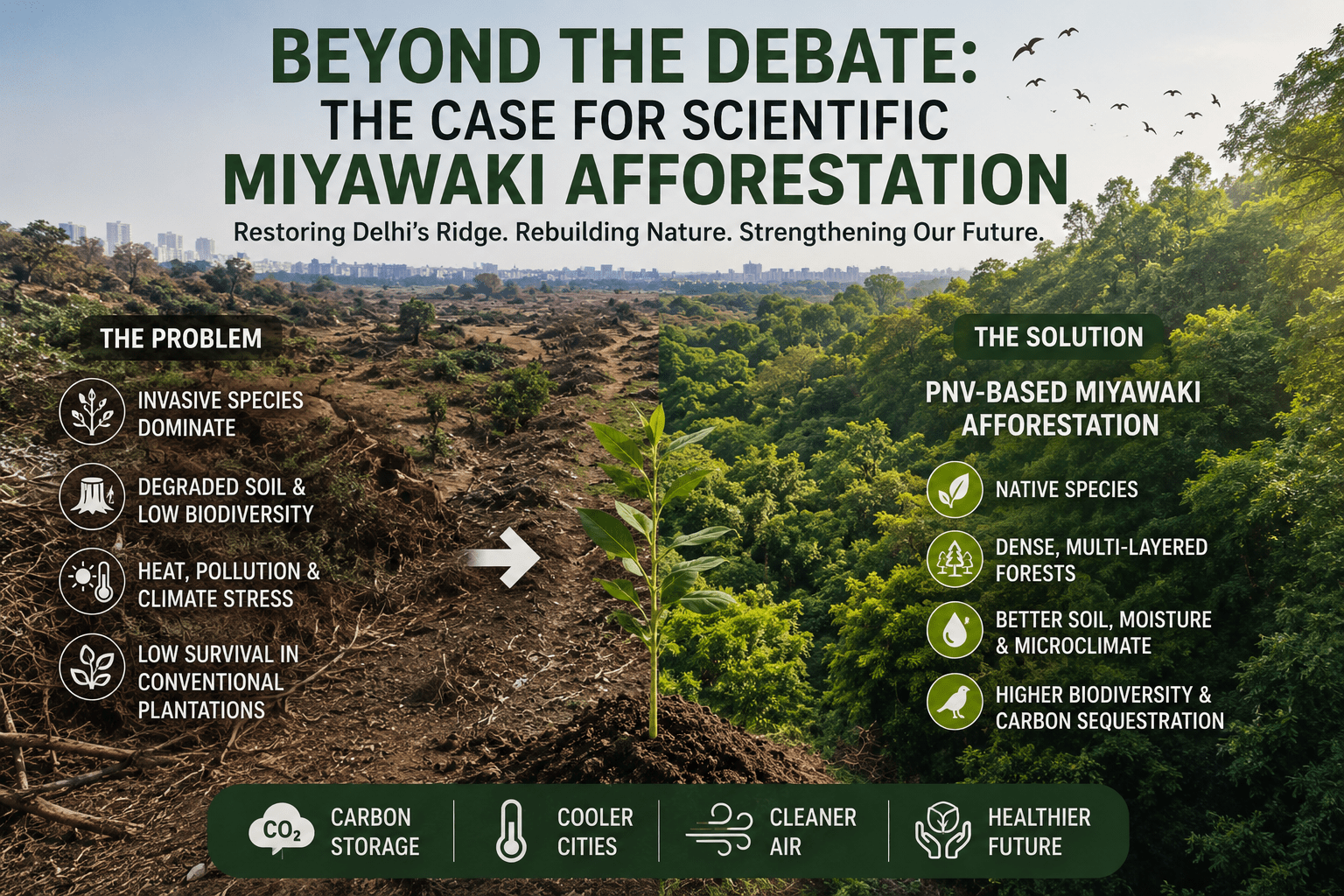
As debate intensifies around the proposal to use the Miyawaki method in Delhi’s Central Ridge, an important distinction is being lost in public discourse: poorly designed plantations and scientifically executed Miyawaki restoration are not the same thing.
Recent reporting by HT Media / Hindustan Times raises valid ecological concerns—but these concerns largely apply to generic, non-site-specific plantations, not Potential Natural Vegetation (PNV)-based Miyawaki restoration.
If applied scientifically, Miyawaki can become one of Delhi’s most effective tools for restoring degraded landscapes, invasive-dominated parcels, and fragmented urban ecosystems.
What Dr. Akira Miyawaki Actually Proposed
Dr. Miyawaki’s work was never about “planting trees everywhere.”
His method was based on:
-Studying Potential Natural Vegetation (PNV)
-Identifying what vegetation would naturally exist without human disturbance
-Using only indigenous species
-Creating multi-layered native forests
Dr. Miyawaki restored over 1,300 sites globally using native vegetation mapping.
Delhi Ridge Is Not Fully Pristine Anymore
A major criticism says Ridge should be left untouched. That is true for intact native grasslands.
But large parts of Ridge today are heavily invaded by:
- Prosopis juliflora (Vilayati Kikar)
- Lantana camara
These invasive species suppress native regeneration.
In such degraded zones, passive restoration may take decades.
This is where assisted succession through PNV-based Miyawaki becomes ecologically justified.
The Miyawaki Afforestation method is best applied selectively in highly degraded, invasive-species dominated patches within the Ridge, where it can accelerate ecological recovery, suppress reinvasion, and establish native protective buffer zones that strengthen and safeguard adjacent sensitive habitats.
Why Dense Planting Works in Delhi
Delhi faces:
- Extreme heat
- PM2.5 pollution
- Fragmented habitats
- Water stress
Dense native planting creates:
1. Faster Canopy Closure :
Trees shade one another, reducing evaporation.
2. Cooler Microclimates
Tiny forests reduce heat stress in urban areas.
3. Improved Biodiversity
Recent studies report significantly higher biodiversity in urban Miyawaki forests.
4. Better Carbon Capture Per Square Meter
Dense, layered forests maximize biomass accumulation.
Water and cost concerns can be managed, not dismissed
The article calls Miyawaki “hugely wasteful of water and massively expensive”.
- Most case studies show high water and cost inputs only in the first 2–3 years, after which the plots are designed to become largely self‑sustaining, with little to no irrigation once canopy closes.
- When life‑cycle costs are considered—lower mortality, reduced replanting, faster soil improvement and ecosystem‑service benefits—Miyawaki can be competitive with repeated low‑survival conventional planting drives.
How to use it:
Instead of comparing one‑time per‑sapling costs, we should compare per‑hectare surviving native cover and ecosystem services after 10–15 years. On that metric, a carefully managed Miyawaki pilot may be more cost‑effective than multiple failed plantation rounds.
Afforestation vs restoration – clarify roles, not confuse them
Critics say “Miyawaki cannot be seen as ecological restoration” and that the Ridge needs full restoration ecology instead.
Miyawaki is primarily an afforestation / rapid revegetation tool—but afforestation and restoration are complementary, not mutually exclusive.
How to use it:
Instead of rejecting Miyawaki outright, Delhi should pilot it on carefully chosen degraded pockets of the Central Ridge with strong ecological safeguards and independent monitoring. That will generate real local data instead of speculation.
Miyawaki Afforestation- New Succession theory :
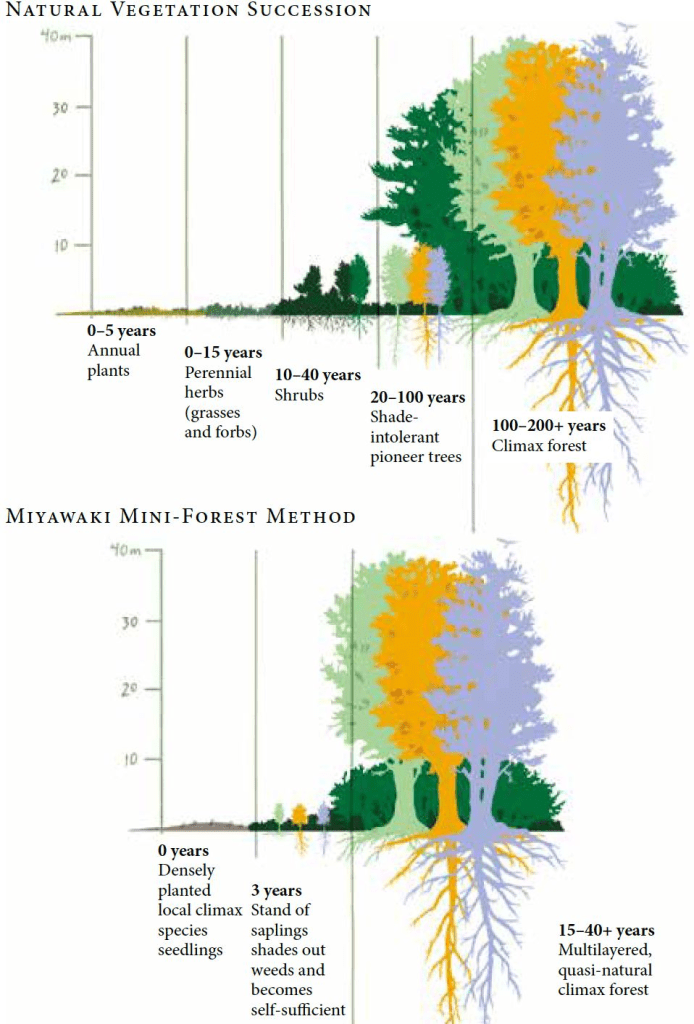
The above diagram compares the natural vegetation succession process with the Miyawaki Afforestation method. In natural succession, the ecosystem evolves over centuries, starting with annual plants and progressing through stages of perennial herbs, shrubs, pioneer trees, and eventually reaching a climax forest over 100–200 years. In contrast, the Miyawaki method accelerates this process by densely planting local climax species seedlings. Within just a few years, the forest canopy quickly establishes itself, shading out weeds, and within 15-40 years, a multi-layered, quasi-natural climax forest develops, creating a self-sustaining ecosystem in a much shorter timeframe. The Miyawaki method provides a rapid and efficient way to restore biodiversity and promote forest growth.
By : Madhukar Varshney (Founder- Rise Foundation)
 Rise Foundation (NGO)