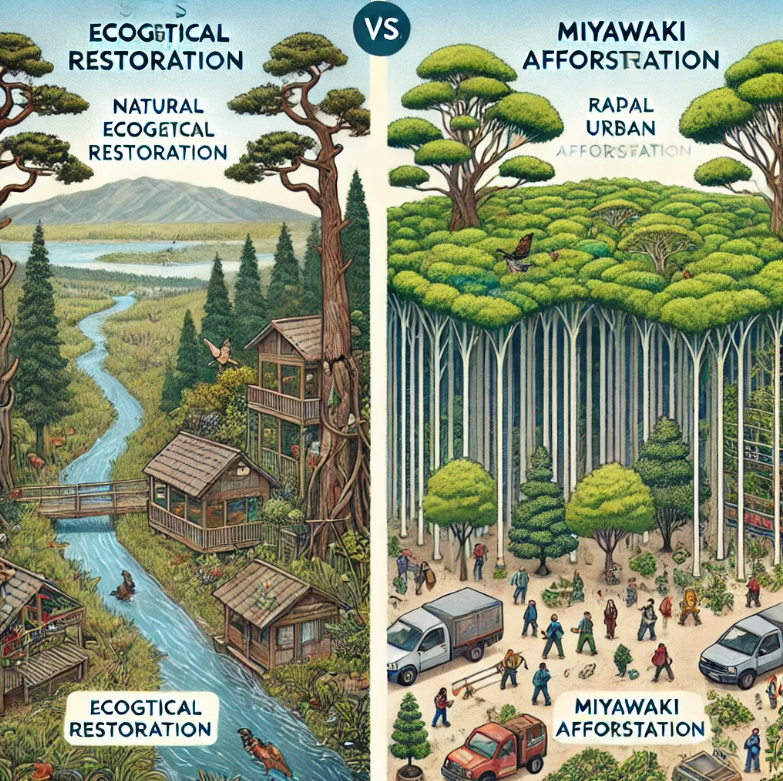
Both SER’s Ecological Restoration approach and Miyawaki Afforestation aim to restore degraded ecosystems, but they differ in methodology, scale, and long-term ecological impact. Here’s a detailed comparison:
| Aspect | SER’s Ecological Restoration | Miyawaki Afforestation |
|---|---|---|
| Objective | Restoring entire ecosystems, including soil, water, biodiversity, and ecological functions. | Rapid afforestation in urban and degraded areas for quick green cover and biodiversity revival. |
| Approach | Large-scale, long-term ecological restoration, often involving natural regeneration and rewilding. | Dense, multi-layered plantation using native species for fast-growing forests. |
| Methodology | – Site-specific restoration plans. – Focus on soil restoration, hydrology, and ecosystem processes. – Passive regeneration where possible. | – High-density planting of 3-5 saplings per square meter. – Uses native species in four vertical layers (shrub, understory, canopy, emergent). |
| Species Selection | – Prioritizes local biodiversity and keystone species. – Encourages natural succession. | – Strictly native species. – Selected based on fast growth, multi-layer canopy structure. |
| Growth Rate | Natural pace, often slow but self-sustaining over decades. | 10x faster growth, self-sustaining within 2-3 years. |
| Land Requirement | Suitable for large-scale landscapes like forests, wetlands, grasslands. | Effective for small urban spaces, degraded lands, and compact areas. |
| Human Intervention | Focus on minimal intervention, allowing nature to regenerate naturally. | High initial intervention (dense planting, mulching, watering), but minimal maintenance after 3 years. |
| Ecological Benefits | – Restores complete ecosystems (soil, water, flora, fauna). – Supports long-term climate resilience. – Increases carbon sequestration and biodiversity. | – Creates urban green lungs. – Improves air quality, reduces heat islands. – Boosts local biodiversity and pollinators quickly. |
| Challenges | – Time-consuming (can take decades for full restoration). – Requires large land areas. | – High initial resource investment (water, labor, compost). – Not a replacement for natural forests, lacks full ecosystem functions. |
| Best Use Case | Large-scale natural ecosystem restoration (forests, wetlands, riverbanks, grasslands). | Urban afforestation, small degraded lands, roadside greening, corporate CSR projects. |
Which is Better?
- SER’s Ecological Restoration is best for large-scale, long-term natural recovery with minimal human intervention.
- Miyawaki Afforestation is best for rapid urban greening and biodiversity enhancement in small spaces.
Both approaches complement each other—while Miyawaki forests create quick-impact green spaces, SER’s full ecological restoration ensures long-term ecosystem health. 🌿🌎
Rise Foundation’s Miyawaki Efforts 🌱
At Rise Foundation, we are actively implementing the Miyawaki method to combat urban deforestation and pollution in Delhi. Through our Million Miyawaki Initiative in association with other social organisations and corporates we aim to plant 1 million native trees by 2026, focusing on government schools, public parks, and degraded lands.
So far, we have:
✅ Planted over 40,000+ native trees across Delhi
✅ Engaged 1,000+ volunteers, students, and communities
✅ Achieved a 90% survival rate with rapid canopy formation
✅ Helped reduce urban heat and improve air quality in high-pollution zones
Our mission is to restore Delhi’s green cover, enhance biodiversity, and create climate-resilient cities using scientific, scalable afforestation models. We welcome collaborations with researchers, SER members, and environmental organizations to accelerate urban ecological restoration! 🌍🌳
 Rise Foundation (NGO)